
How to Prepare for Government exams in 2026
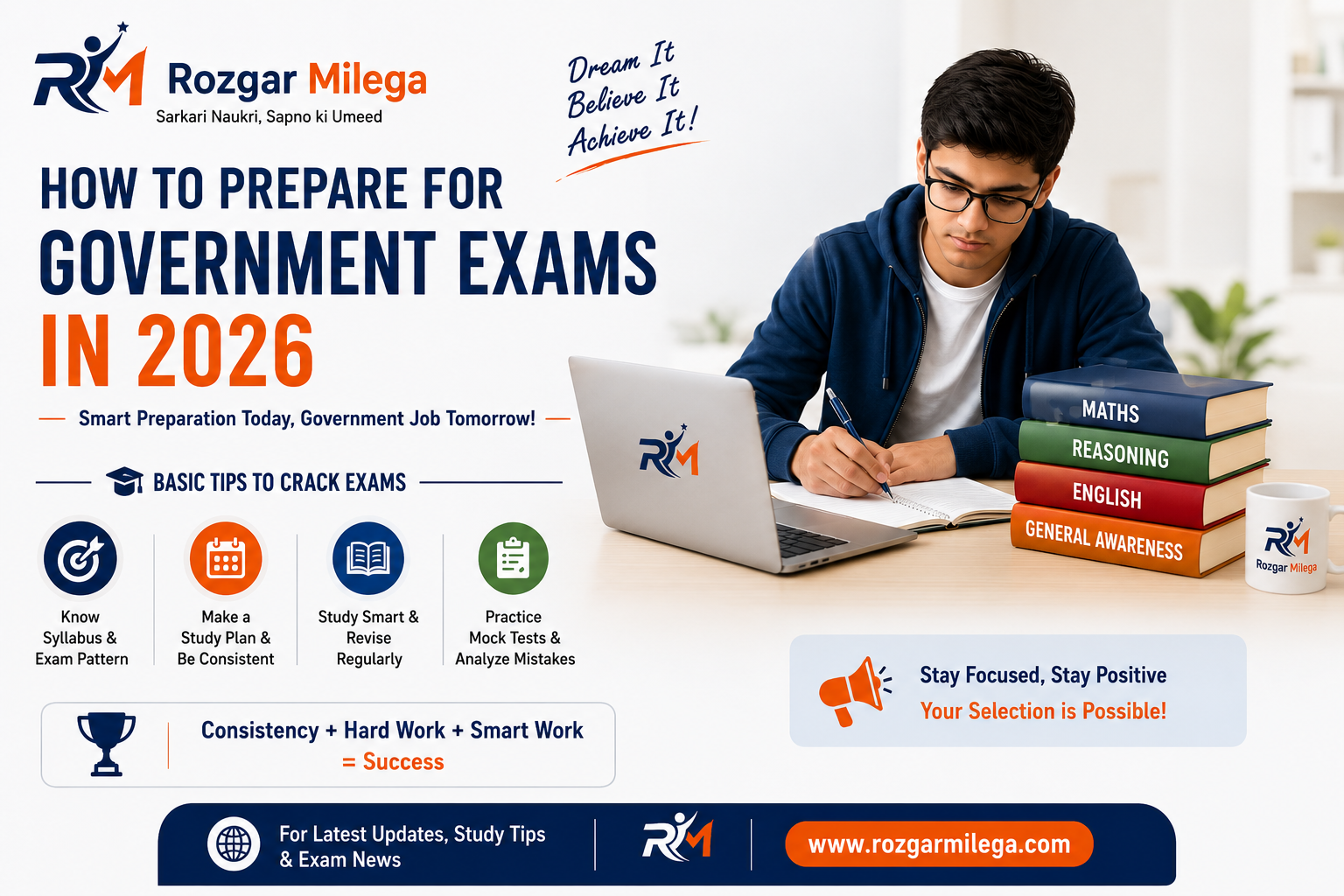
How should I start preparing for a government job in 2026?
Preparing for a government job in 2026 requires a clear plan, regular practice, and consistency. First, decide which type of government exam you want to target, such as SSC, Banking, Railways, Defence, or State Government exams. Different exams have different eligibility requirements and syllabuses, so always check the official notification before starting your preparation.
Start by understanding the exam pattern and syllabus. For many competitive exams, important subjects include Quantitative Aptitude, Reasoning, English, General Awareness, and Current Affairs. For example, SSC examinations commonly test areas such as reasoning, general awareness, mathematics, and English.
Create a realistic daily study timetable. Begin with 3–4 hours of focused study and gradually increase your study time. Give extra attention to subjects in which you are weak. Make short notes and revise important formulas, facts, and current affairs regularly.
Practice previous-year question papers to understand the types of questions asked and improve your speed. You should also take mock tests regularly and analyse your mistakes. This helps improve accuracy, time management, and exam confidence.
What Should I Study First for Government Job Preparation?
If you are starting government job preparation in 2026, begin with the subjects that are common in most competitive exams. You do not need to study everything at once. Start with the basics and gradually increase the difficulty.
Quantitative Aptitude (Maths)
Start with basic topics such as number system, simplification, percentage, ratio and proportion, average, profit and loss, simple and compound interest, time and work, and time, speed and distance. Build your calculation speed through regular practice.
Reasoning
Begin with analogy, classification, series, coding-decoding, blood relations, direction sense, syllogism, and basic puzzles. Once your basics are strong, move to more difficult reasoning questions.
English
Focus first on grammar, vocabulary, reading comprehension, sentence correction, error detection, and fill-in-the-blanks. Reading an English newspaper or useful articles daily can also improve your vocabulary and comprehension.
General Awareness & Current Affairs
Start with Indian history, geography, polity, economics, science, and basic general knowledge. Along with this, read current affairs regularly, especially important national events, government schemes, awards, sports, and banking/economic news.
Previous-Year Questions
After learning the basics, solve previous-year question papers. This helps you understand the actual exam level and identify your weak areas.
How many hours should you study daily?
If you are preparing for a government job in 2026, you should ideally study for 4–6 focused hours every day. However, the right number of hours depends on your current level, target exam, and other responsibilities.
If you are a beginner, start with 3–4 hours daily and gradually increase it to 5–6 hours. Avoid studying for long hours without breaks because quality and consistency are more important than simply counting hours.
A simple daily schedule could be:
2 hours:- Maths /Quantitative Aptitude
1.5 hours:- Reasoning
1 hour:- English
1 hour:- General Awareness & Current Affairs
30 minutes:- Previous-year questions or revision
If you have limited time, even 2–3 hours of focused study every day can be effective if you follow the routine consistently.
What mistakes should I avoid during preparation?
While preparing for a government exam, avoiding common mistakes can save you a lot of time and improve your chances of success.
Studying Without a Plan
Do not start studying randomly. Create a realistic timetable and set daily and weekly targets.
Using Too Many Study Materials
Avoid collecting many books, apps, and online courses. Choose a few reliable resources and complete them properly.
Ignoring Previous-Year Papers
Previous-year questions help you understand the actual exam pattern and difficulty level. Make them an important part of your preparation.
Not Taking Mock Tests
Mock tests help improve speed, accuracy, and time management. Take them regularly and analyse your mistakes.
Ignoring Weak Subjects
Do not study only your favourite subjects. Spend extra time improving areas where your performance is weak.
Skipping Revision
Learning a topic once is not enough. Revise regularly so that important formulas, concepts, and facts stay fresh in your memory.
Focusing Only on Study Hours
Studying for 10 hours does not guarantee success if you are distracted. Focus on productive and consistent study rather than simply counting hours.
Ignoring Current Affairs
For exams that include General Awareness or Current Affairs, make a habit of reading important updates regularly.
What is the biggest mistake students make?
One of the biggest mistakes students make while preparing for a government job is studying without a proper plan. Many students collect multiple books, watch different teachers, and use several study apps but do not follow a consistent study schedule. This can waste time and create confusion.
Another common mistake is focusing only on learning new topics and ignoring revision. Students may complete the syllabus but forget important formulas, concepts, and facts because they do not revise regularly.
Many students also avoid practising previous-year question papers and mock tests. Knowing the syllabus is not enough; candidates need to improve their speed, accuracy, and time management through regular practice.
Some students spend too much time on one difficult subject while completely ignoring their stronger or weaker areas. A balanced preparation strategy is more effective.
Finally, inconsistency is a major problem. Studying for 10 hours one day and then doing nothing for the next few days will not produce good results.
How Do I Know If My Preparation Is Going in the Right Direction?
Knowing whether your government job preparation is going in the right direction is important because it helps you identify problems early and improve your strategy. Simply studying for many hours does not always mean you are making good progress.
The first sign of good preparation is improvement in your mock test scores. Take regular mock tests and compare your results over time. If your marks are gradually increasing and your mistakes are decreasing, your preparation is moving in the right direction.
You should also check your accuracy and speed. Government exams are usually time-bound, so you need to solve questions correctly within the available time. If you are becoming faster without losing accuracy, it is a positive sign.
Another important indicator is your syllabus progress. Keep a simple record of the topics you have completed, revised, and still need to study. Completing a topic once is not enough; you should be able to remember and apply what you have learned.
Pay attention to your weak subjects as well. If a topic that was difficult for you earlier is becoming easier after regular practice, it shows that your preparation is improving.
You should also regularly solve previous-year question papers. If you can solve questions from your target exam with increasing confidence, you are becoming more familiar with the actual exam level.
Do I need to join coaching, or can I prepare at home?
You do not necessarily need coaching to crack a government exam. You can prepare successfully from home if you have a proper study plan, reliable study materials, and the discipline to study consistently.
Home preparation is a good option if:-
You can understand concepts through books or online classes.
You can follow a daily timetable without someone monitoring you.
You are comfortable practising questions on your own.
You can regularly take mock tests and analyse your mistakes.
Coaching may be helpful if:-
You struggle to understand basic concepts on your own.
You have difficulty creating a study plan.
You need regular guidance and doubt-solving.
You find it difficult to stay disciplined while studying alone.
If you are a beginner, you can first try self-study for a few weeks. Use free or affordable online resources, study the syllabus, solve previous-year papers, and take mock tests. If you feel that you are still struggling with particular subjects, you can consider coaching for those areas.
Can I crack a government exam without coaching?
Yes, you can crack a government exam without coaching. Many students prepare through self-study using books, online resources, previous-year papers, and mock tests. Coaching can provide guidance, but it is not compulsory for success.
The first step is to choose your target exam and understand its syllabus, exam pattern, and eligibility requirements. After that, create a realistic study timetable and follow it consistently.
Use reliable study materials and focus on understanding the basics of subjects such as Maths, Reasoning, English, General Awareness, and Current Affairs, depending on your exam. Solve previous-year question papers regularly because they help you understand the types and difficulty of questions asked.
Mock tests are also very important for self-study. They help you measure your preparation, improve your speed, and identify weak areas. After every mock test, spend time analysing your mistakes instead of simply checking your score.
You should also maintain regular revision. Make short notes for important formulas, facts, vocabulary, and current affairs so that you can revise them quickly.
What should I do in the last month before the exam?
The last month before a government exam should focus on revision, practice, and improving speed and accuracy. Avoid trying to learn everything from the beginning.
Start by revising the complete syllabus and focus more on topics where you frequently make mistakes. Revise important formulas, concepts, vocabulary, grammar rules, and General Awareness notes regularly.
Solve previous-year question papers to understand the actual level of the exam. Try to complete them within the given time limit. You should also take full-length mock tests regularly, preferably under exam-like conditions. After every mock test, analyse your wrong answers and identify the topics that need more practice.
If your exam includes Current Affairs, revise important events from the relevant months instead of trying to read everything again.
During the final week, focus mainly on revision and mock-test analysis. Do not start multiple new books or courses because this can create confusion and stress.
Also, take care of your sleep, food, and mental health. Avoid staying awake late every night just to increase study hours.
So, this was all about how to prepare for government jobs in 2026. I hope these tips help you start your preparation in the right way. Keep studying, keep practicing, and stay consistent. All the best for your preparation and your exam. Thank you for reading.
Related reading
- How to Prepare for Government Exams While Working Full-Time
- How to Master General Awareness and Current Affairs for Government Exams
- Understanding Government Exam Stages: Prelims, Mains and Beyond
- A Beginner's Guide to Government Jobs in India